Did the president of the United States try to persuade an ally to investigate a possible election opponent?
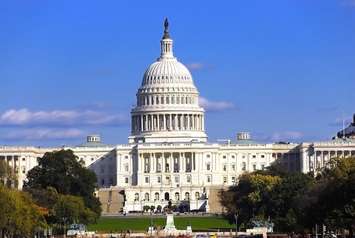
That is one of the questions members of Congress are trying to find the answers to as the first day of a public impeachment inquiry took place Wednesday in Washington. Members of the U.S. House Intelligence Committee are holding this inquiry to determine if President Donald Trump committed a crime while in office. The investigation is designed to provide the House committee with information to help them decide if Trump should be impeached.
At the centre of the inquiry is a controversial telephone call made by Trump to Ukrainian President Volodymyr Zelensky. It is alleged that during the call, Trump tried to persuade him to have his government investigate former U.S. Vice President Joe Biden and his son Hunter, in exchange for military aid to Ukraine.
Impeachment supporters have said this quid pro quo arrangement was a blatant attempt by Trump to influence next year's presidential elections, and thus a violation of the president's oath of office. Those backing Trump have called the inquiry a partisan "witch hunt" generated by sour grapes over the outcome of the 2016 election. Trump himself has denied any wrongdoing.
On Wednesday, the House committee heard testimony from Ambassador Bill Taylor, the top U.S. diplomat on Ukrainian affairs, and George Kent, deputy assistant secretary at the State Department's Bureau of European and Eurasian Affairs.
Both Taylor and Kent were given a chance to make opening remarks, and committee members then questioned them. Democratic members had the first 45 minutes, then, Republican members had another 45 minutes.
Kent talked about what, according to CNN, was described as a "corrupt, pro-Russian leadership" of Ukraine before 2014, when their president fled the country for Russia. Kent also testified that Trump's lawyer, former New York City Mayor Rudy Giuliani, helped orchestrate a "smear campaign" against the former U.S. Ambassador to Ukraine.
Taylor provided new details of a July 26 phone call between Trump and Gordon Sondland, the American Ambassador to the European Union. Taylor testified that an aide had overheard the phone call, which took place the day after the infamous call with Zelensky. Taylor said he was told that Trump was more interested in having the Bidens investigated than providing military aid to Ukraine.
This is the fourth time in U.S. history that public hearings have been held on the question of impeaching a president. The first three times resulted in articles of impeachment being drafted. Andrew Johnson was impeached and acquitted in 1868 over alleged violations of the Tenure of Office Act. Bill Clinton was acquitted in 1999 for lying to a grand jury about an extramarital affair with a White House intern.
Articles were drafted in 1974 against Richard Nixon over his involvement in the Watergate affair, but Nixon resigned from office before the full House could vote on them.
The inquiry is scheduled to continue on Friday morning.