


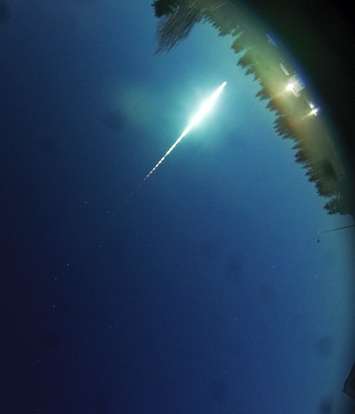
A fireball that streaked across the sky over Alberta is challenging long-held beliefs about the giant cloud of debris on the very edge of the Solar System.
State-of-the-Art Global Fireball Observatory cameras operated by the University of Alberta captured the grapefruit-sized meteoroid, dubbed the Wincombe Fireball, on February 22, 2021.
The long-held belief is the Oort Cloud consisted solely of icy objects. Occasionally the gravity of a passing star would nudge these travellers toward the Sun, and we would see them as comets with long tails.
However, researchers at Western University have proven this fireball was made of rock. They published their findings in the journal Nature Astronomy.
 (Photo courtesy of NASA).
Scientists have yet to observe the Oort Cloud directly but know when objects originate from the region because of their orbit. In 70 years of fireball observations, that path has always brought icy travellers toward the inner Solar System.
"This discovery supports an entirely different model of the formation of the Solar System, one which backs the idea that significant amounts of rocky material co-exist with icy objects within the Oort Cloud," said meteor physics postdoctoral researcher Denis Vida. "This result is not explained by the currently favoured Solar System formation models."
Vida called the discovery "a game changer."
Previously observed rocky fireballs have always originated much closer to Earth, sometimes from the meteor belt between Mars and Jupiter.
 (Photo courtesy of Nature Astronomy)
During its flight over Alberta, the Winchcombe fireball descended deeper into the atmosphere than icy objects on similar orbits. It also broke apart the way scientists expect a rocky meteorite would.
Comets are made of ice and dust and slowly vapourize as they approach the Sun, giving them the distinctive tail that stretches for millions of kilometres.
"We want to explain how this rocky meteoroid ended up so far away because we want to understand our own origins," explained Vida. "The better we understand the conditions in which the Solar System was formed, the better we understand what was necessary to spark life."
Scientists believe the Oort Cloud formed 4.6 billion years ago. Theories suggest the gravity of the outer planets pushed icy planetesimals left over from planet formation away from the Sun. The galaxy's gravity then deposited them outside the heliosphere.