


An associate membership has been created by the Association of Community Pastures to operate this region's first community pasture on land leased from the St. Clair Region Conservation Authority.
Lambton Cattlemen's Association President Chad Anderson said it took some time because all of the land that's currently in the province's community pastures today is owned property.
"It's very critical for us to become members, because it allows us access to some provincial funding for community pastures, but more importantly, we get to fall under the umbrella of their insurance that would be a substantial cost for us otherwise," Anderson said.
He said an action plan can be created now to develop the official association.
"All the work on the community pasture has been done by a working committee that was established from the Lambton Cattlemen's Association," Anderson said. "The community pasture itself will be a standalone organization. So, right now we're putting in place plans to create that membership and then from there, we'll have an elected board that will operate the pasture."
Anderson said they're hoping to share a rough outline of the action plan at the Lambton Cattlemen's Association Annual General Meeting on January 14, 2026.
He said they've always had three goals in mind for the project.
"One was to support the beef herd in Lambton County. So, the cattle that will be grazed here will all be breeding females. Our second goal was to make [grazing access] a priority for young farmers under 38 years of age," Anderson.
They also hope to develop a demonstration component to educate people about grazing management techniques.
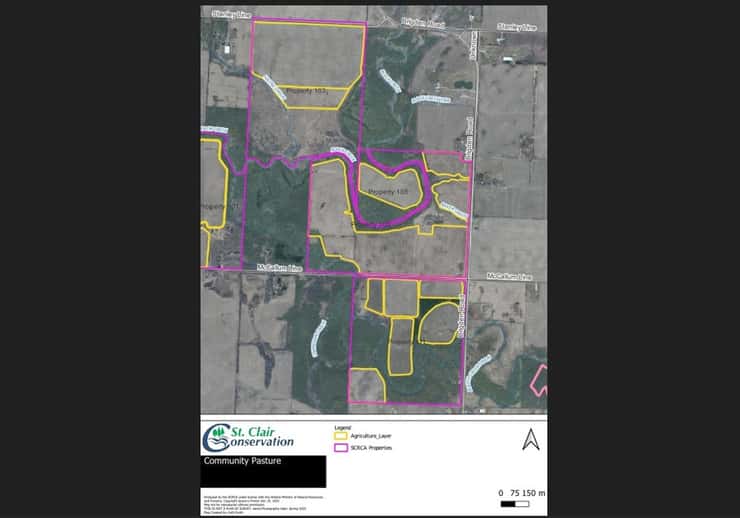
"The land is south of Brigden, near Wallaceburg. It's part of a 600 acre [property] that was taken by the Darcy McKeough floodway when it was put in. The land that the conservation authority picked is very sensitive and best suited for grazing. It's really nice to see the conservation authority acknowledge that it's the best use for the land," Anderson said.
He said they hope to expand use to the full 600 acres eventually, but 200 acres is a good start.
Anderson said the land will be properly seeded in grass and fences installed in 2026, with cattle grazing to begin in 2027.