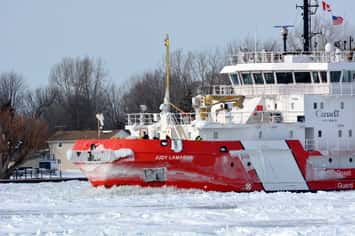
The Canadian Coast Guard (CCG) has deployed two of its newer vessels to assist with local icebreaking operations this year.
The CCG Ship Judy LaMarsh, a light icebreaker, was acquired as an interim solution while the existing fleet undergoes maintenance and work to extend service life.
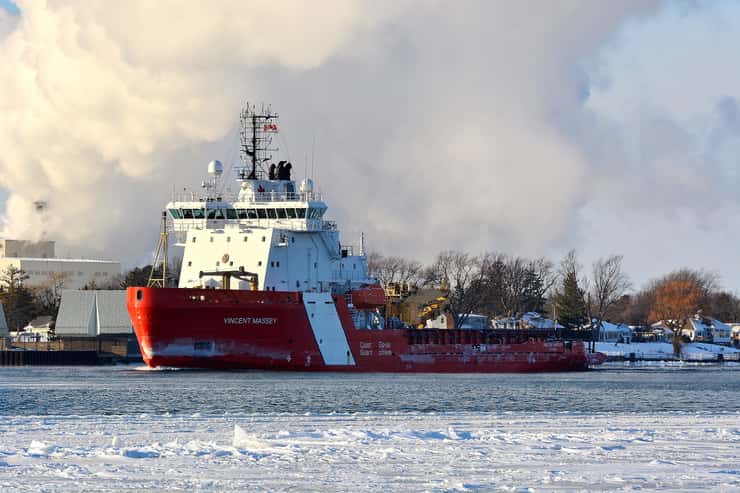
The CCG Ship Vincent Massey, a medium icebreaker, was converted from a commercial icebreaking vessel.
Both ships were dedicated into service in 2023.
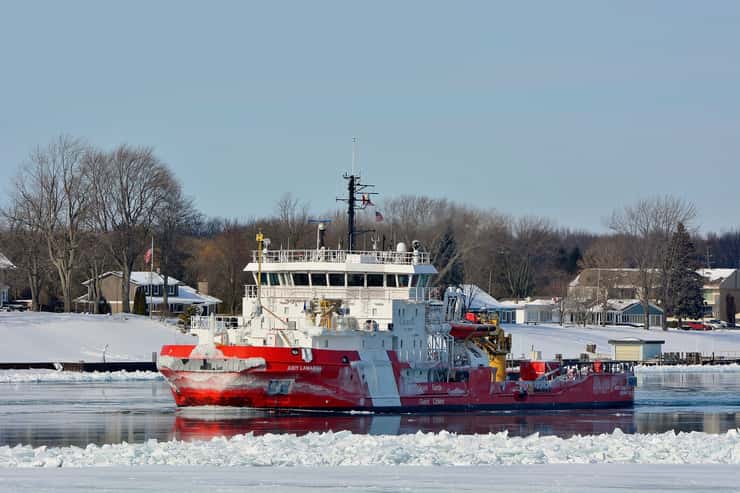
Central Region Icebreaking Superintendent Guillaume Paradis said crew members on both vessels are rotated every 28 days.
"[On the] Judy LaMarsh there are 26 people usually on board, and the Vincent Massey is a bigger unit, with usually between 28 and 30 people on board," Paradis said.
Paradis said repairs and maintenance are being done to the ships that regularly travers our waterways.
"The Samuel Risley has an issue with oil leaking in its shaft, and the Griffon is in a dry lift right now," said Paradis. "So, that's why we have those units on the Great Lakes this winter."
Paradis said they work in partnership with United States Coast Guard Cutter's Bristol Bay and Neah Bay, and both Canadian and U.S. Coast Guard helicopters monitor ice conditions as well.
"The conditions are not severe, but all units are working to make the ice flow well in the river and escort ships. We're pretty busy, but it's manageable," Paradis said.
A second ice bridge has formed just north of the Blue Water Bridge this winter.
"We had another ice bridge form a few weeks ago, but it collapsed," Paradis said. "Now, we have a new ice bridge. It's a good ice bridge because it's approximately 2.6 miles (4.18 kilometres) wide north of Sarnia and it's holding well with southwesterly winds.
The naturally forming structure helps protect the river and its connecting waterways from a rush of ice floes.
"When we have to do some [ship] escorts in Lake Huron, we reduce the speed when we cross this ice bridge to protect the bridge as [best] as we can," said Paradis.
Earlier this week, Paradis said Lake Huron's ice coverage was 54.2 per cent, while the St. Clair River was fairly open in the Sarnia area.
He said the river was more principally ice-covered, with thin lake ice and brash ice along the ships tracks, south of Corunna.
Ice breaking operations - which include escorting ships, flood control, and commercial harbour breakouts - kicked off in the Great Lakes sector on December 21, 2025.